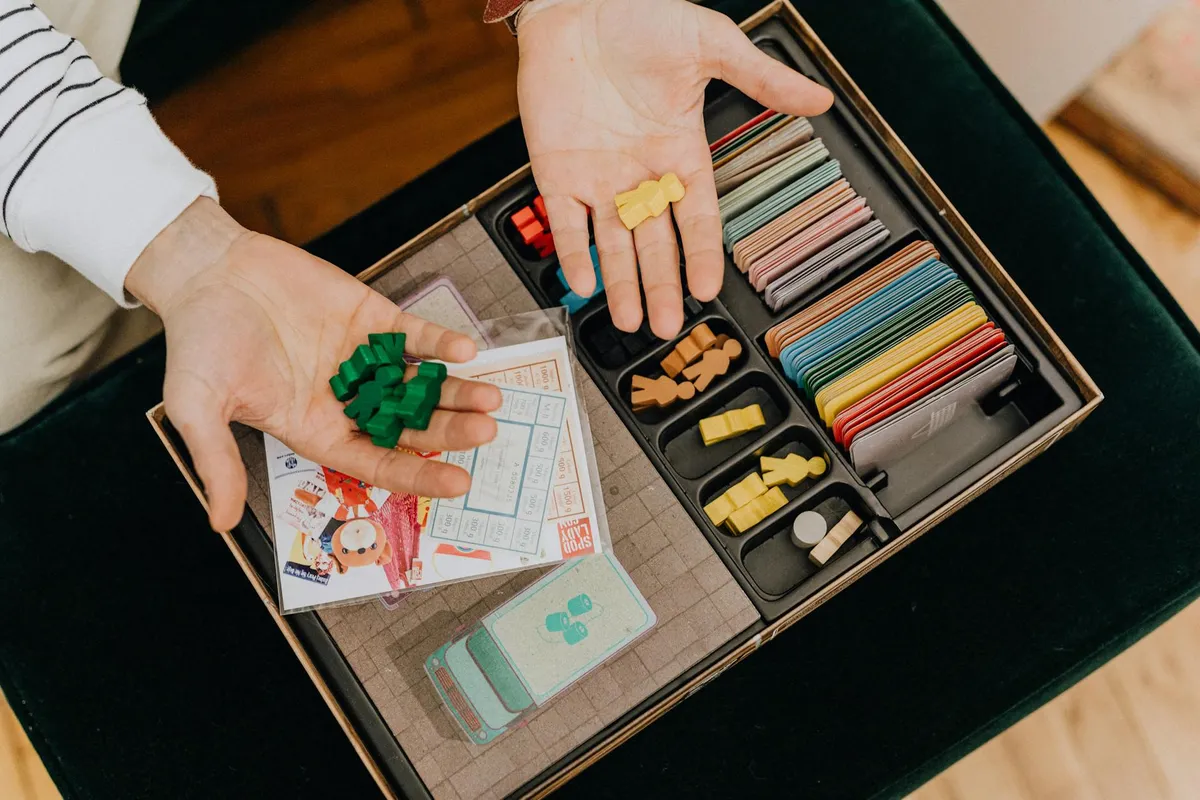
The setup of a board game is rarely discussed in design writing. Reviews mention it briefly, usually to complain about its length. Designers are praised for elegant mechanics, balanced economies, satisfying endgames. The fifteen minutes between unboxing the components and starting the first turn — the period in which the game becomes physically present in the room — is treated as overhead, as the cost of admission to the actual game.
This framing is incomplete. The setup phase is itself a design problem, with its own craft and its own emotional logic. Some games handle it badly and never recover; others handle it so well that the setup becomes part of the experience the game produces. Worth treating with the seriousness the rest of the design receives.
Setup as transition
The most useful frame for thinking about setup is as a transition between modes. Before the game begins, the room is in whatever mode the day has produced — distracted, perhaps, or tired, or restless. By the time the game begins, the room must be in game mode: attentive, present, oriented toward each other and the table. The setup is what moves the room from one to the other.
Good setup design uses this period rather than wasting it. The components emerge in an order that builds anticipation. The table fills gradually with things that look interesting. Some early choices — color of player pieces, starting position, opening hand — give players the small early ownership that pulls them into engagement before the rules become demanding. None of this is required by the mechanics. It is the work of design choosing to take the transition seriously.
The visual choreography
Component design plays into setup in ways the casual observer might not notice. The order in which a game asks you to lay out components affects how the table looks at every stage of the unboxing. A game that asks you to place the most visually striking elements last produces a different experience than one that places them first.
Wingspan again: the bird tray is set up before the player tableaus, which means the table is already populated with beautiful illustrations before any individual player starts to build. This was almost certainly a deliberate choice. The first impression of the table — the moment that determines how the next two hours will feel — is one of abundance and beauty, not of empty space waiting to be filled.
The narrative beat
Some setups tell a small story. The unboxing of Spirit Island, with the modular spirit boards and the slowly assembled island, is a kind of narrative. You are establishing a place, populating it with characters, preparing to defend it. The game has not yet begun in mechanical terms; the experience has begun in narrative terms. The setup is the first beat of the story the game intends to tell.
Compare with games whose setup is a flat utility task. The components emerge in no particular order. The table fills with logistical objects. The first impression is of work to be done. The game can recover from a setup like this, but it must recover, where a well-designed setup gives the rest of the experience a head start.
The participatory decision
The strongest setup phases involve players in early choices that matter. Drafting starting components. Selecting a faction. Choosing among initial positions. These decisions are not yet under the full pressure of the game; players make them while still relaxed, while still in the gentle phase of the evening. The decisions still feel meaningful — they will affect the rest of the game — but the cost of making them imperfectly is low.
This combination of meaningful and low-stakes is rare in game design. The setup phase is one of the few places it appears naturally. Designers who recognize this can use the setup to give players ownership of their position before the difficulty of the actual game arrives. Players who have made early meaningful choices arrive at the first turn already engaged in a way that players who have been handed a starting position have not.
The bad setup
Bad setup is mostly a matter of pacing and density. Too many components asked for too quickly. Rules required to be parsed during the physical assembly. Choices presented before the game has been understood well enough for the choices to feel like choices. Each of these turns the setup from transition into work, and the work casts a shadow over the play that follows.
There are well-loved games with bad setup phases. The community absorbs the cost and continues to love the games. But the game has recovered from its setup, not benefited from it. The design ceiling is lower than it would have been with better setup work.
The case for taking setup seriously
Setup design deserves more attention than it receives — both in design discourse and in the reviews that shape consumer choice. The fifteen minutes before the first turn are not waste. They are the period during which the room becomes the game. Designers who treat that transition with care produce evenings that begin better than evenings that begin badly. The compounding through the rest of the night is significant.
The hobby would be slightly improved by reviewers who scored setup design alongside mechanic design, by designers who optimized for the transition rather than only the play, and by players who noticed when a setup had been handled well. Quiet craft, but craft.