Most game nights underperform. Not catastrophically; the friends arrive, the games are played, the evening is pleasant. Pleasant is the upper limit on most game nights, and pleasant is well below what a well-hosted game evening can be. The difference is mostly the hosting.
This essay is about the hosting craft — the small choices made before the friends arrive that determine whether the evening will be merely pleasant or one of the evenings that gets remembered. Most of the choices are low-cost and high-leverage, which is the standard signature of hosting work generally.
The pre-arrival hour
The hour before guests arrive is the most important hour of a game night. It is when the table is set, the lighting adjusted, the food prepared, the wrong games removed from the cabinet. By the time guests arrive, all of these decisions should be made and most of them should be invisible.
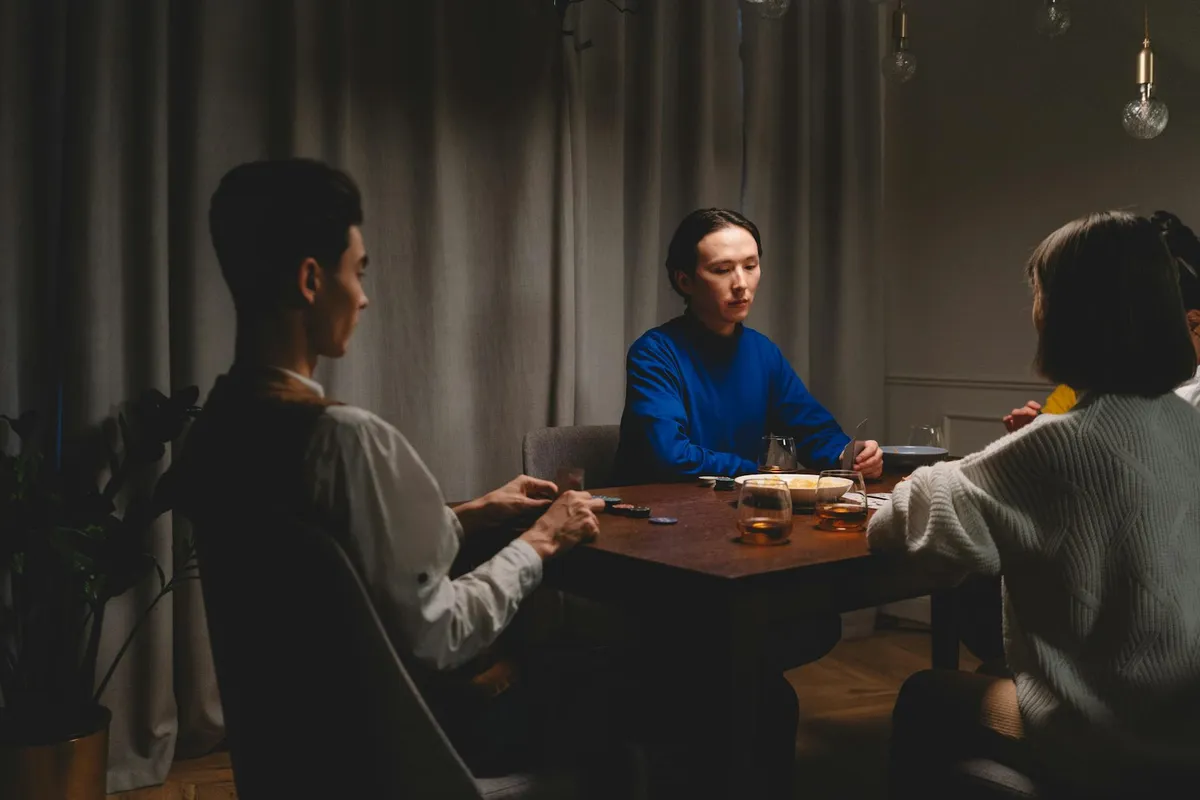
The lighting is the easiest improvement most hosts overlook. Overhead lights produce the wrong mood for a game evening. A few warm lamps near the table — bright enough to read cards, soft enough to feel like an evening — change the room more than any other single intervention. The cost is the cost of a lamp. The return is durable.
Food is the second easiest improvement. Snacks that can be eaten with one hand and that do not leave residue on cards are a small kindness that good guests will notice and bad guests will fail to notice but benefit from anyway. Olives, almonds, pretzels. Sliced fruit. Anything that does not require a plate or a fork. The board-game-specific consideration matters: Cheetos are bad for components in ways that take years to fully reveal.
Game selection as social design
The choice of what to play is half hosting and half curation. The right game for an evening depends on the group: their experience, their attention span, their relationships with each other, their mood. The same group can need different games on different nights.
A few principles that have held up across many evenings:
Match difficulty to the least-experienced player. A game that requires four pages of rules will not work for a group that includes one new player, regardless of how patient the new player is. The patient new player will play the rules, not the game, and will not enjoy the evening. Pick something the new player can actually engage with.
Match length to the actual evening. A four-hour game starting at 8pm is a five-hour game ending at 1am, and people are tired and stop having fun at hour three. Be honest about the time available. Three shorter games will produce more memory than one long one.
Match interaction to the group dynamic. Some groups want a game where they can talk freely and the game is in the background. Some want a game that demands close attention and minimal conversation. Picking the wrong type for the wrong group produces an evening at cross-purposes.
The opening fifteen minutes
The first fifteen minutes of a game night set the mood for the rest. Before the actual game begins, there is the period of arrival, drinks being poured, conversation being established, the choice of what to play being discussed. A good host moves this period along without rushing it. Long enough to settle in; short enough that the evening doesn't lose momentum.
One small move that consistently helps: have a "warmup" idea ready. A short, easy game (Just One, Codenames, something light) for the first twenty minutes, before the main game of the evening. The warmup absorbs the mismatched arrival energy and produces a clean transition into the main event.
Rules explanation as hosting
Explaining rules well is its own craft. The instinct to read the rule book aloud is wrong. The instinct to explain everything before starting is also wrong. The right approach is closer to: explain the bare minimum required to make the first three turns possible, then explain the next layer once players have seen the first layer in action, then explain the third layer when the third layer becomes relevant.
This staged approach respects how learning actually works. Players cannot retain twenty minutes of abstract rules; they can absorb three turns of concrete play and then layer additional structure onto the experience they have already had. A host who masters this pacing produces game nights that include rules-heavy games without losing the people who would otherwise be lost.
Knowing when to end
The hardest hosting decision is when to stop. The temptation is always toward one more game. The reality is that the marginal return on the fourth game of the evening is almost always negative. People are tired. The conversation has become repetitive. The next morning will be earlier than it should have been.
A good host ends the evening one game before the group would have. The last memory is of an evening still in motion rather than an evening winding down. The friends leave wanting more, which is the mood that produces the next game night.
The cumulative effect
Each individual hosting choice — the lighting, the food, the warmup game, the rules pacing, the knowing when to end — is small. The cumulative effect across an evening is significant. The well-hosted game night and the poorly-hosted game night begin in nearly identical conditions and arrive at quite different places by the time the friends are putting on their coats.
The compound effect across years is greater still. Friends who have had a string of well-hosted game nights at your house will keep coming. Friends who have had a string of pleasant-but-underwhelming evenings will say yes to the invitations but will plan less around them. The hosting craft, accumulated, becomes the social fabric.
The hobby is, in the end, about the evenings. The games are excellent and beautifully made. The evenings, when hosted well, are the thing.