By every reasonable forecast made twenty years ago, the board-game hobby should have died. Smartphones were already pulling at evenings; streaming would soon arrive to take the rest. The friction of a tabletop game — the setup, the teardown, the requirement that other humans physically be in the room — should have made it the wax-cylinder of entertainment, lovely but obsolete.
It did not happen. The opposite happened. Through the 2010s and into the 2020s, the board-game industry grew: in dollars, in titles published, in cafés that serve as venues, in the cultural visibility of the hobby itself. The friction did not kill it; the friction may have been part of why it survived.
The economy of friction
A tabletop game requires a kind of effort that screen entertainments do not. You must clear a table. You must set out the components. You must read or remember rules. You must invite or be invited; you must sit close to other people for the duration. Each of these is a cost. Each is also, on closer inspection, the reason a board-game evening produces an experience that watching a film together does not.
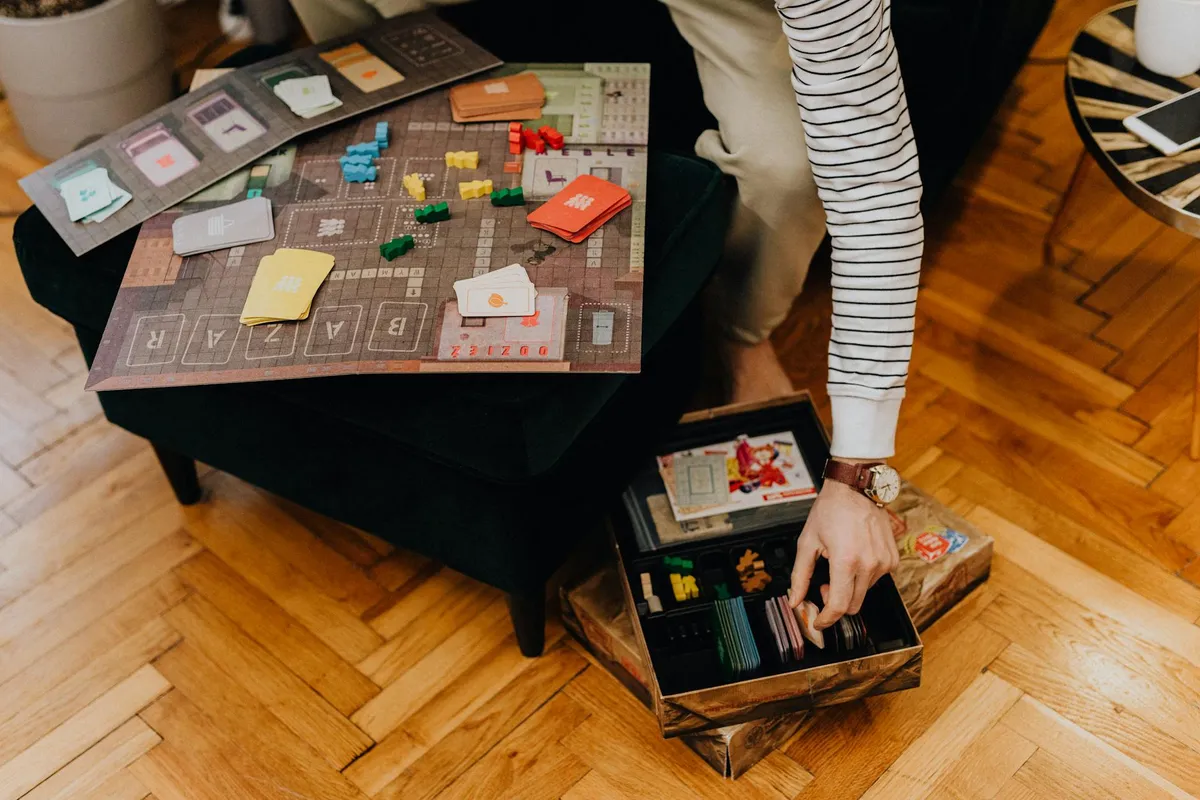
The setup, viewed sympathetically, is a transition. The fifteen minutes of laying out a Catan board are not wasted preamble; they are the period during which the room shifts mode. Phones drift to side tables. Voices change pitch. Whatever was bothering the day softens. A small ritual, accomplished cooperatively, makes the rest of the evening possible.
Against the screen
It is not quite right to say that board games rose because screens fell. Screens did not fall. They expanded in nearly every direction. What happened is more interesting: as screens occupied more of the texture of ordinary days, the value of an alternative — any alternative, but particularly one that demanded shared physical presence — increased.
The board game became, by accident, anti-default behavior. Choosing to play a board game is choosing not to scroll, not to stream, not to do the easier thing. The hobby grew partly on the strength of its unreasonableness. Two hours of Wingspan instead of two hours of background television is a deliberate choice in a way that watching television is not, and the deliberateness produces a sense of having spent the evening on something rather than having let the evening happen.
Cooperative versus competitive
The growth of cooperative games during this period is its own story. Pandemic. Spirit Island. Gloomhaven. Forbidden Island. The cooperative game is a relatively new shape in the medium — earlier eras of mass-market board games were almost entirely competitive — and its rise tracks a cultural appetite for being on the same side as the people you play with.
This is, perhaps, what the hobby finally figured out. The competitive game produces a specific kind of evening: tense, a little adversarial, occasionally bruising. The cooperative game produces a different one: collaborative, slightly anxious in the same direction, more often warm. Both have their place. The shift in market share toward cooperative play in the 2010s and 2020s suggests something about what people now want from an evening with friends — less to defeat each other, more to face something together.
The café phenomenon
The board-game café is now a recognizable urban form. There is one in most cities of any size; there were almost none in 2005. The café exists because the hobby needed a venue that wasn't someone's living room — a place to try games before buying them, to play without owning, to gather with a group too large for any one apartment.
The café is also, in its way, a defense of the hobby against itself. Owning two hundred board games is a financial and spatial commitment most people cannot make. The café removes that commitment and lets people participate in the hobby as users rather than owners. The economic logic is closer to a bowling alley than to a record store. It works because the experience of the games is the product, not the games themselves.
What persists, persists for reasons
It is tempting to read the survival of board games as nostalgic — as proof that older, slower forms have value the digital culture cannot match. This framing is partly correct and partly wrong. Modern board games are not slower than the games of forty years ago; in many respects they move faster, with cleaner rules and more elegant mechanics. The hobby that survived is not the hobby of Risk and Monopoly. It is something newer and better, and its persistence is not nostalgia but design improvement meeting an audience that wanted what the design improvements offered.
The cardboard endures, in other words, because it is good at something the screen cannot do well: producing an evening among present people, accomplished together. The rituals around it — the setup, the rule explanations, the post-game discussion — are not overhead. They are the experience.
Twenty years from now, the prediction is the same as the prediction twenty years ago. The hobby will die. Some new form will displace it. The prediction was wrong then; it will probably be wrong now. The friction is the feature.